(stay attentive)
On social synchronization, memory, and the molecular logic of belonging
Some environments make it easier to stay in motion. Not because they agree with you or motivate you, but because they quietly reduce the work required to decide what comes next. Timing settles. Effort lands. You stop renegotiating each step.
This is easiest to see in places built around return.
Homes.
Churches.
Incubators.
Laundromats.
Laboratories.
Relationships.
Different purposes, similar mechanics. Constraint matters, repetition matters. You show up again. The rules are mostly the same, and the feedback is legible. Over time, behavior compresses into patterns that cost less to run. That compression is a groove.
Grooves form when expectations become reliable. The nervous system learns which actions reduce uncertainty and which ones amplify it. Attention narrows toward what matters here. Alternatives don’t disappear, but they stop competing so loudly. Movement feels smoother because fewer internal corrections are required.
At the molecular level, this process is well described.
Dopamine signaling participates by updating predictions about outcomes. Rather than tracking pleasure directly, dopamine reports whether results match expectation and whether a pattern of action should be reinforced, a mechanism classically described as reward prediction error encoding (PMID: 27069377). When the same social moves consistently resolve prediction error, those moves stabilize through learned reinforcement dynamics (PMID: 33197709). The system leans into them. Less recalculation is needed.
That stability recruits broader neuromodulatory systems. Dopamine, serotonin, norepinephrine, and acetylcholine act primarily through G-protein-coupled receptors, tuning excitability, synaptic gain, and plasticity across large neural populations. These GPCR-mediated systems establish background conditions that bias what feels effortful, tolerable, or worth attempting, shaping behavioral landscapes over extended timescales (PMID: 38862331). When a groove holds, neuromodulatory tone becomes predictable. The brain runs quieter.
Relationships engage this machinery with unusually tight feedback loops. Shared routines, emotional signals, and mutual expectations train two nervous systems to anticipate each other. Coordination improves. Small deviations register quickly, and repair becomes efficient. As long as prediction remains reliable, the groove feels natural. When it doesn’t, friction appears first in the body, long before it becomes a coherent story.
Memory binds these grooves to place and practice. Experiences are stored as distributed neural ensembles that reactivate when familiar cues return. Each reactivation renders the memory labile and allows it to be updated with the current physiological state before storage again, a process central to memory reconsolidation (PMID: 27885549). The groove persists, but it is never entered in exactly the same way twice.
Leaving a groove raises the cost of movement. Prediction error increases. Effort rises. The system begins to test alternatives, often without announcing why. Restlessness or fatigue appears before clarity. Language comes later, once the nervous system has already started to reorganize.
Plasticity remains throughout life, though it becomes more selective. With experience, prediction models sharpen and the energetic cost of revising them increases, making large-scale reorganization possible but less automatic (PMID: 25261907). Some grooves persist because they remain efficient. Others loosen when maintaining them requires more correction than they return.
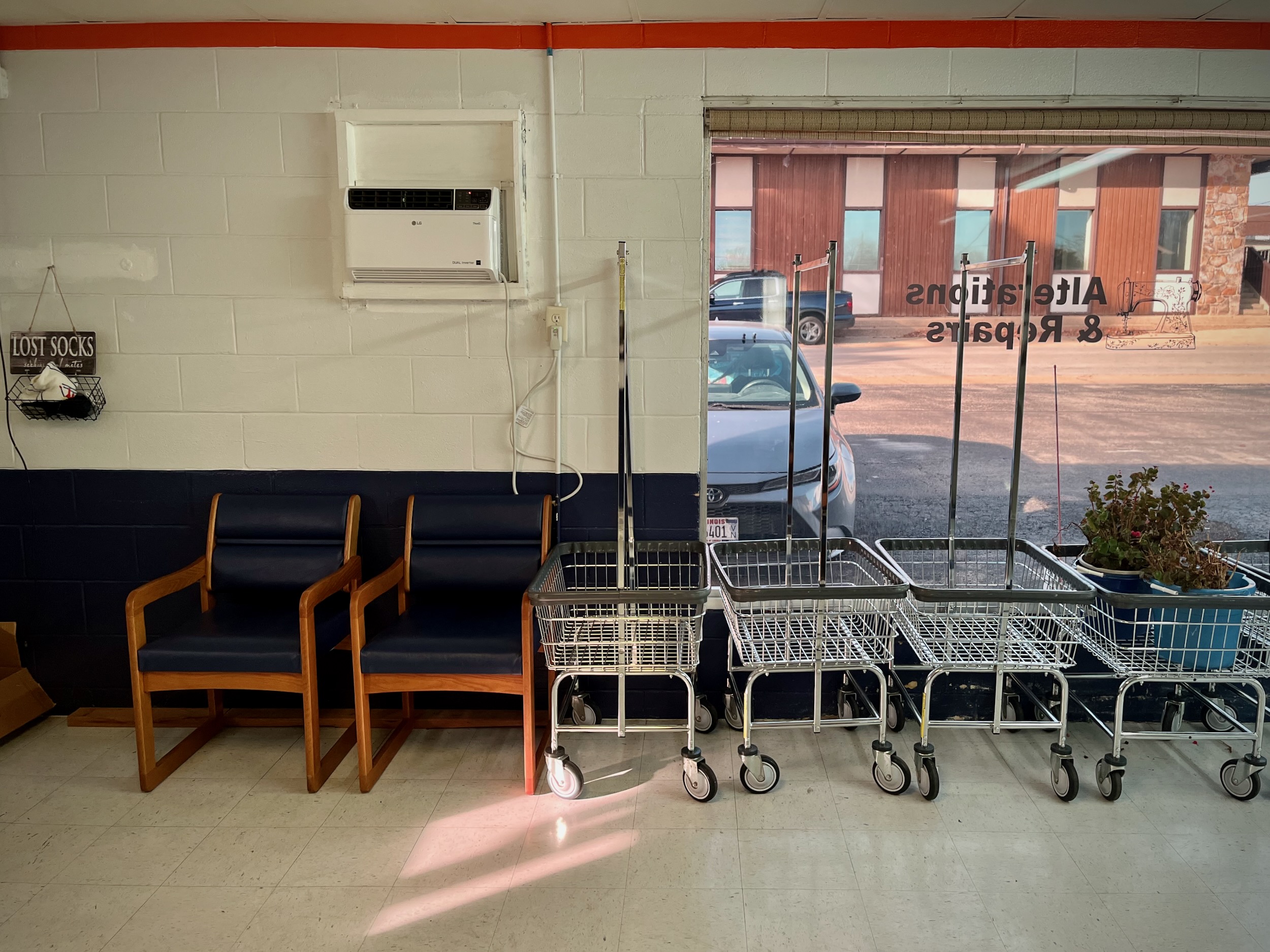
I thought about this while standing in the Poly Clean Center in Mountain Home, Arkansas. I’ve been coming to this laundromat, on and off, for more than twenty years. It hasn’t changed much. The machines run their familiar cycles. The chairs are still placed for waiting that has a known duration. The rhythm of the room is intact.
I am not.
Standing there again made it easy to feel how grooves accumulate quietly. I’ve moved through that same room carrying different assumptions about effort, belonging, and reward. The place kept its timing. My expectations shifted. The groove stayed available, even as the version of me that fit it best changed.
Grooves persist because they reduce friction. They allow behavior to run on learned expectations rather than constant recalculation, and they fade when those expectations stop paying off. Leaving one rarely announces itself. More often, it begins as a subtle increase in drag.
Seen this way, identity is not a fixed trait or a declared position. It is a history of synchronization: a record of which rhythms the nervous system has learned to inhabit, and which ones it is gradually releasing. Some grooves remain accessible long after departure. Others close without ceremony.
Occasionally, standing in a familiar place long enough, several grooves become legible at once. The ones that shaped you. The ones that carried you for a while. The ones you no longer quite fit. In those moments, identity feels less like something to protect and more like something to examine, guided by a simple question: which patterns still reduce friction, and which ones no longer do.